Making an Impact: Locally Week 1 review
This past week in Making an Impact: Locally, we learned about many different issues that impact Rochester, the United States, and the world as a whole. We watched a video from Ibram X. Kendi, who has written and spoken about the subject of Antiracism. According to Kendi, an antiracist is someone who actively opposes racism and racist systems, rather than just someone who isn’t racist. We talked about how that would look in our community, especially in regards to housing, which led into our discussion of redlining in Rochester. Even in the past few years, a map displaying the races of homes throughout the Greater Rochester Area will tell you that we are a very segregated city. Apparently, the boundary between Penfield and Rochester is the most segregated in the Nation! But how did it come to be that way? In discussing the history of Rochester, we looked into the Housing Act of 1934. This legislation decided what races and ethnicities could live where, in zones ranging from perfectly safe to dangerous. The safer, suburban real estate was open only to white people who could afford it, while the minorities were left to the unkept inner cities. Consequences of these past actions unfortunately still live with us. Obviously, it can be hard to break the pattern of where people live, but there is more. For example, during Kodak’s prime, their company housing was extremely segregated. Even today, some neighborhoods still have rules that only white people can buy property there. It is truly despicable that segregation, an issue that was supposed to be solved long ago, is still persistent in the town I live in, let alone America.
After reading and learning about Rochester’s history, we also had a discussion about enslaved people. My Jigsaw for this discussion was on advertisements for freedom seekers. I learned that enslavers were willing to pay $800+ for someone to return “their” enslaved person. It was difficult to read that some people viewed others as nothing more than property, and that NY newspapers were okay with it. I also read about one enslaved person who ran away when he was 100 years old. I was impressed that even at such an old age, he still had the courage to achieve some sort of freedom.
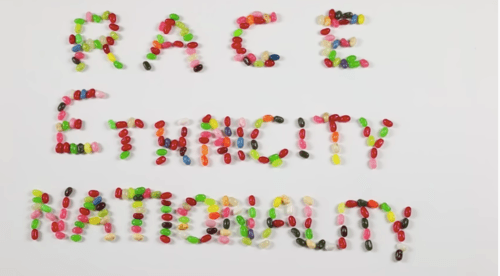
After covering those heavy issues, we talked about race, ethnicity, nationality and identity. In short, race is a human construct/categorization based upon one’s appearance, ethnicity is one’s ancestry or heritage, and nationality is where someone holds citizenship or their national origin. I enjoyed learning about these differences with the jelly bean video. The video explained that someone’s race is like the color of the jelly bean, while ethnicity is the flavor, and nationality is the bag it came from. Our discussions got deeper when we moved into identity, a more personal subject. We went around the class sharing our identity and watched a video of someone else explaining their own. Identity is made up of many different parts such as: where you live, where you were born, where your parents/grandparents were born, what your gender expression is, what you think of yourself, and what others think of you. I think this conversation was a good reflection tool to help me better understand who I am.
Most recently, we talked about cultures in Africa. Since the standard NY K-12 curriculum does not really include any deep dive into African history, we looked at some African art ourselves. Most notably, we analyzed a painting of Mansa Musa of the Mali Empire. In the painting, Mansa Musa wore a crown and held a shimmering piece of gold as he sat in a throne covering the vast territory of his rule. What I remember most from the video we watched about him was that Mansa Musa is the richest man in all world history. Also, he had a famously long pilgrimage to Mecca, with a caravan that stretched as far as the eye could see.
About The Author